
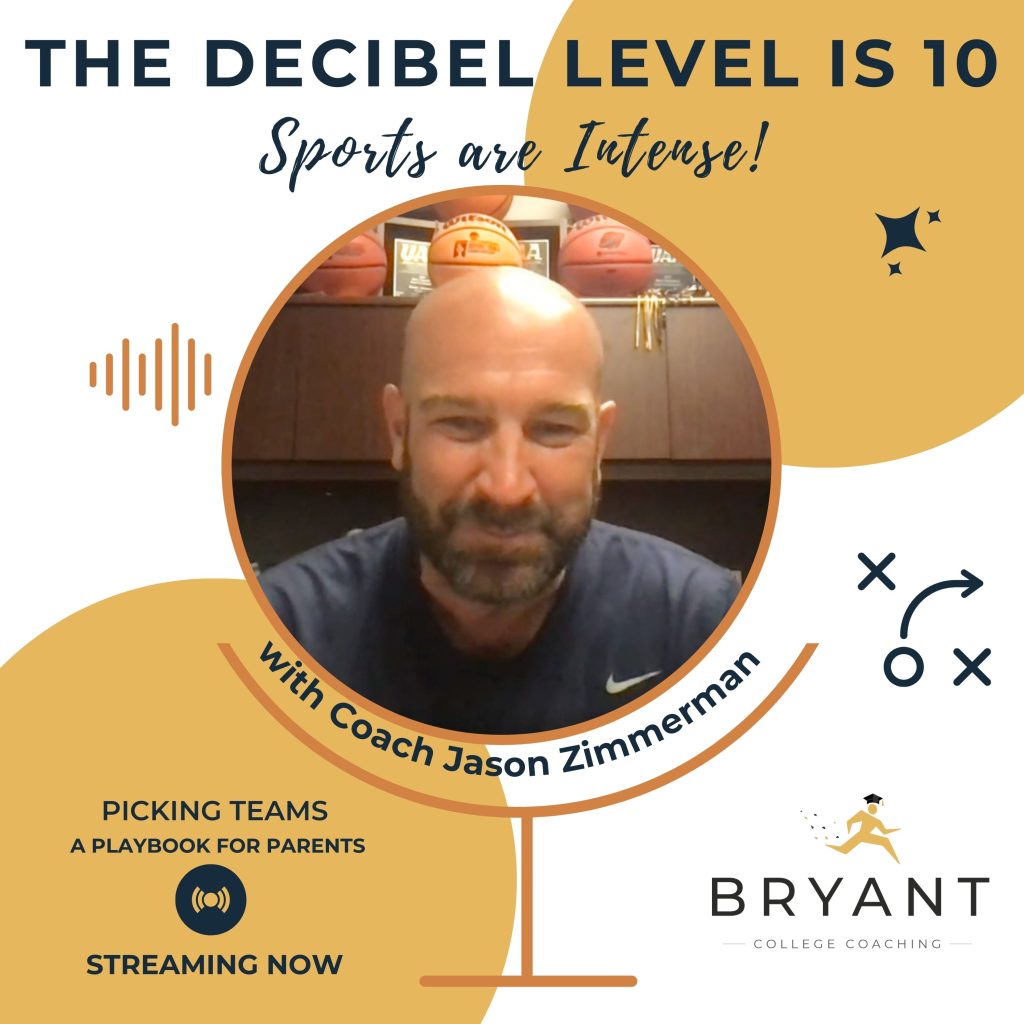
Today’s Play on Picking Teams: A Playbook for Parents reveals the importance of receiving genuine interest from recruits. Coach Bryant, of Bryant College Coaching, sits down with Jason Zimmerman, head men’s basketball coach at Emory University, to share the value of authenticity over perfection in communication and highlights the challenges posed by COVID-19, which hindered his ability to coach and interact with his team. Jason also addresses the frustration of dealing with generational differences and the necessity of adapting to new coaching methods. He advises parents to support their children without overstepping and to focus on the process rather than the outcome in sports and recruiting. The transcript is available below.
Today’s Coach: Coach Jason Zimmerman. Jason is a current Division III Head Men’s Basketball Coach and Director of Coach Z’s Basketball Camps. He has over 28 years of college coaching experience including stints at the University of Evansville, his alma mater Davidson College, and now Emory University where he’s been since 2007.
Amy Bryant 00:00
Amy. Welcome to Amy teams podcast that dives into the playbooks of seasoned coaches. I’m your host. Amy Bryant, a 23 year veteran college coach, and my guests hail from the professional, college and youth ranks. Together, we’ll share real stories from our coaching experiences to empower you as parents to be positive forces in your child’s sports journey. Hello everybody, and welcome back to picking teens a playbook for parents. Today, we are excited to have Jason Zimmerman back on the show. Jason is a current division three head men’s basketball coach and director of coach Z’s basketball camps. He has over 28 years of college coaching experience, including since at the University of Evansville, his alma mater, Davidson College, and now Emory University, where he’s been since 2007 So Jason, tell us, what does it take for a student athlete to let you know that they are genuinely interested in your program?
Jason Zimmerman 01:13
Takes a lot, though, like, there’s a lot of time and effort just not on like, on my part, for sure, but there’s a lot of time and effort on the student athletes part, right? Like to care about something so real, and that’s what makes it genuine, right? It’s great to write a note, but how can you make it you like? How can you make it different than just hey, this is what affected me when I was on a visit, right? Or when I talk to you. This is what really touched me. Everything’s gonna like be this like moment, right? You can make it. I don’t need, when I get notes, I don’t need perfect grammar, right? Like, I don’t write in perfect No, I don’t speak grammar, right? So it’s not me. So if I write a perfect note, and it’s perfect grammar, and it’s probably not coming from me, right? So that’s where, like, it’s genuine, it’s real, right? And I think sometimes we don’t, we spend so much time trying to make it perfect, then, no, just get it out there, like,
Amy Bryant 02:08
that’s right. And you know, that just made me think of something else that I say to these kids all the time, because a lot of times they’re nervous to send their highlight video to coaches, because it’s not perfect, and my sentiment to them is, just get it done. Coaches try to watch that maybe once, if you’re lucky, they might not even make it to the end of it. So don’t spend so much time on something that they really, you know, don’t care that much about it, much rather see you play in person. But I mean, don’t. The point is, don’t let perfectionism hold up your process in the recruiting you know, recruiting be reading, alright, so just switch. See the opposite side of this. Now, what’s the most frustrating thing you dealt with as a college coach?
Jason Zimmerman 02:53
Yeah well, that’s an easy one COVID 100% you’re not even close when you know. So somebody can take away what you love to do for year, and like, not just here, but like just in the world, like just, you know, I couldn’t coach my guys, I couldn’t be with my guys. I couldn’t I couldn’t run camps. And I know how frustrated you get, like wicked camps, but it that’s just what makes me go right. Like, that interaction and like, and then on top of that is everything. Now after, you know, like, you know, we got the fifth year. You got the fifth year guys that are still playing, which is great, but it’s just different, like, and the frustration, the frustration of that is like, hey, these high school guys are coming in to college, and so like, how do you deal with just that whole, whole episode, right? Which I think is everybody is feeling the same thing, but for me, that what was frustrating about that was just the time with our student athletes, right? And somebody just said, took your purpose right away. Like, no, you can’t be with them. That was frustrating. You know, you went through with us. It was really frustrating. And understand, like, Hey, you had to make decisions. But that was frustrating. The other thing I’d say, that’s frustrating, it’s not frustrating. But I think I get frustrated when people say, Well, we used to do it like this, or these kids aren’t like that. They used to be ain’t no kidding. Like my dad said the same thing, like I wasn’t like they were when they were growing up. The generation before that said the same thing. I think I get frustrated that. And I get frustrated sometimes that myself. And I said, Well, you know what? 10 years ago here, we would have done this. And guys were like this, and they Hey, guess what? It’s not 10 years ago. Like, figure it out. Like, coach you guys, right? Like, don’t give me Don’t give me problems. Give me solutions. Like, these are our guys. That’s who they are. Like, let’s figure out, like, how we’re going to coach these guys, how we can coach them better and also not lose track of, like, what’s important, right, our base of who we are and what we do, our code and how we coach and hold them accountable, and but, you know, there’s things that we did 17 years ago when I got here, and I’m like, That was smart. Like, why were we doing that? That did it like, that didn’t go but when at all, and it didn’t help my relationship with any of my guys. Like, so those two big frustrations, obviously, the COVID piece of taking a year and a half, really two years of our lives, to get back and playing and coaching and teaching, and then that part of like, well, these kids are different. Well, these kids are different. They’re different. That’s our job. Like, yeah, our job is to figure that out. And, and I still think today and like, kids want to be coached like kids want to become they want to be challenged. They want to be coached like, I didn’t want to be challenged a coach in a different way, right? Like, I would still be defiant in ways to my coaches, like, or think, what are we doing and but we just did what they said. Now they’re like, they’re actually smarter than me, right? Like, these guys are actually smarter than me. So, like, Yeah, I’ve been through 30 years of coaching, so, you know, I’ve tried that that didn’t work, like, I tried that it didn’t work. But sometimes, and a lot of times, I listen when they come in an office, and we listen to them, like, them, like, that’s really good. Like, we need to, like, think about that, and, and maybe not our basketball piece, but like, our does that really matter? Like, how we do that in practice, or when we have that meeting? Should we? Should we look at it this different way? And, and I think that’s what’s great about being at Emory is you’re constantly on the, like, the up and coming, like, Hey, can we do this better? Hey, can we do this better? Hey, because that’s what, that’s what Emory does, right? That’s what the whole campus is doing. Like, hey, can we cure cancer? Hey, can we, you know, do this better? Hey, can we and so, like, if we’re not doing that as coaches, then, then that’s wrong. Now, don’t get me wrong. You know this, I’m old school. Like, I like, I like to be accountable and go at it and work hard. But I don’t think that’s old school. I think that’s just good, like, old school. That’s just who wants to be good with us, you know? So I think those two things, if I had to, the sense of, oh, these kids are different, so they’re not as good. No, it’s not right. Like this figures out, right? And then the COVID year,
Amy Bryant 07:27
well, I think, I think that’s just such a great mindset, too. I mean, it’s such a teaching mindset. It’s like these kids are different, so let’s figure out how to work with them. And you know, that’s exciting to a teacher, to a coach. It’s exciting to have new ways and new challenging ways to to present, your practices and to communicate and all that stuff. I mean, when things get stale, it’s when you know, it’s because we’re doing it the same way. So you know, you gotta welcome the change.
Jason Zimmerman 07:54
And also so the other thing, I think, is boredom is the biggest obstacle of greatness. Because like to be great, you gotta do certain things. So, so hey, if we’re going to be a great basketball so we gotta pass, catch, dribble, shoot, like, and I’m not gonna like, I’m not gonna wave a magic wand and come up with like, 100 new ways to shoot it better, right? Like, bro, you gotta go, you gotta go shoot, right? And so if you’re gonna get bored at shooting, then you’re probably not gonna be a good shooter, right? I’m not a tennis person, you know that. But if I’m gonna get born serving, right? Like, if I can, I go out there and serve too. And like, Well, I gotta do something different. Well, then you probably need to work on her serving. It’s more like, so, like, so that piece of it is, is the routine of that, and not getting bored with what we do is really important, however, like, all right, is there a better way to teach shooting and not teach necessary? But can we do a drill that does the same thing that’s a little bit different, like, and so those two are the go hand in hand, right? Like, not letting kids, because also nowadays, you know, with the phone, like, it’s a two second attention span, right? Like, if we don’t do a drill, if we do a drill for seven minutes, kids are losing their money. No, no, we have to concentrate longer than seven minutes. So let’s work on concentrate longer to seven minutes. As you know, our game may take an hour and a half, right? It’s gonna take a long oh, let’s do that, but let’s also be smart about how we’re doing that, right? And so, yeah, it’s that’s coaching, right? It’s two plus two equals six sometimes, right? Why? We talked about, like, Yeah, and like, this year we lost nine games under four points. And, you know, I, if I wasn’t bald, I’d be bold, right? So, but, but it. But during the summer, all we talked about is like, hey, what can we do? Just be this much better. Because if we’re that much better, we’re gonna be really good.
Amy Bryant 09:46
Yeah, that’s great. Speaking about going bald, or Yeah, things that make you go bald. You are a father. You mentioned your kids earlier. So you got one baseball player, you got one volleyball player. What advice could you share for parents who are listening in regards to the recruiting process, but not only recruiting process. I mean, you kind of mentioned that already. I guess more about being a supportive parent to a college student,
Jason Zimmerman 10:20
Well, first of all, so when my son played basketball, I would try to work with him, and we’re out in the back working, and he told me, Dad, the game has passed you by. And I’m a parent now, I was doing that as a dad, but I’m also a professional, like basketball coach, right? So if you could say that to me, then like, hey, as a dad, you got no shot to try to teach your kids how to play, right? Like, you just got no shot but, but I joke about that, but it’s also like, just being a supportive parent is so hard, right? So I get the same feelings that every parent ever right, like, Oh, my kids should play. Oh, I wish you know this coach did this. Oh, this coach did that. Like, I have all those feelings sitting in the stands, and it’s really hard for me not to say something, not not to the coach, because I don’t, but to say, like to yell to I don’t my kids didn’t play basketball. So it’s a little bit easier. I don’t know anything about volleyball or baseball, a little bit now, but I think the hardest thing to do is, while you’re while your kids are performing, you can’t just cheer for them, right? Like they’re not going to hear you, right? They’re not going to hear you while they’re performing, especially like tennis, like you’re going, like they got already worried about performing, right? There’s no, there’s no reason to, like, hey, you know, give them advice from the stands, right? That’s my pet. Like, you’re talking about recruiting watching. When I watch parents do that, I’m like, I don’t know if I want to coach that guy, right? Like, and that’s really hard, right? And that’s really hard to do, and I know because I’ve been through it, right, as a parent, right? Um, the other advice is, what we just talked about earlier was you’re never going to feel like you’re doing enough, right? You just, it just doesn’t happen. You’re not going to feel like you’re doing enough. When my kids got into sports, I was fortunate enough to get a scholarship to go to Davidson, and I wouldn’t have never been able to go, but I told my wife, I said, Look, we’re not going to do this to get scholarships. Like, that’s not what we’re doing this week, like, and if we ever start doing that, then we gotta just reevaluate. What we need to do it for is I’m going to put him on a team or her on the team, and we’re going to go through we talked about earlier life lessons, right? So maybe, maybe you didn’t play well, maybe you need to get a little bit better, and you need to improve your skills, right? Maybe, maybe you didn’t play, and maybe you were the best person on the team, but maybe there was a conflict with the coach, right? Well, then we gotta deal with conflict solutions, right? We gotta deal with conflict here. Like, it’s not going to be perfect, hey, maybe, maybe something happened where I’m like, I have to learn to work with this teammate who’s not working as hard as me, but is more successful than me. He produces women. He’s better than me, and he’s I work way harder than him, but he’s just better than me. Oh my gosh. How long does that happen? How many times it happened in life? Right? So we gotta, we gotta work through all these things, and the only, not the only way, but the best way to do it, is through sport and team and working and competing and figuring out and like, as a dad, I want to take all that hurt away from my kids, all of it like I just want them to be successful. I don’t want them to feel sad, angry, depressed, anxious, right? But I don’t know this happened over here. I think there is we talk about mental health a lot, right? And mental health is having the proper reaction to the stimulus, right? So I get beat, I should feel sad, depressed, angry, maybe a little bit like, you shouldn’t feel happy when you get beat. If you feel happy when you get beat, we need to look at our mental health, right? Like, no, no. Like, where something happens that’s that’s hard. Like, you should probably have those feelings a little bit right now. How we deal with them is going to be, like, how we help our mental health, right? But I should have this, this the proper reaction to the stimulus, right, whatever it is. And hey, if you care about sport and you care about playing and winning, if the coach doesn’t play, or if your teammate is working not as hard and doing better, there’s going to be feelings in there, right? And so as a dad, I want my kids to work through those feelings. Like, come on, work through those things now. Amy, I’ll tell you this, I’m not great at it. I fail a lot in that, right? I tried to take the hurt away from my son and my daughter as much as possible, right? And my wife too, you know, so, but I think that’s the thing. By going into sport, that’s why you go into sport, is to learn how to deal with conflict, how to compete, how to deal with things that go well, how to do things that go poorly, how to do like, and so when you lose track of that, like, Hey, I just want my kid to get a scholarship to go here. Like, okay, if that’s if that’s what you want. But I think you just lose all these teaching moments because, as when, when you’re 40 and you’re done. Like, does it really matter that I played at Davidson College, but it really matters that I had a great coach that taught me a lot of lessons, right? And I had teammates, and I went through these lessons, and I tried to learn these lessons. And don’t get me wrong, I love Davidson College. I love my basketball team. I would not ever do anything different than that, and it helped me get this job help. I mean, it’s been unbelievable, but it’s really been those, those moments where I’ve been able to grow that that comes from now my kids, luckily, both been able to go on and play college athletics and but it hasn’t been easy, right? It’s sometimes I was like, man, should I have just not gone in athletics at all, ever. Sometimes you think that, right, that because when your son is struggling, or your daughter’s struggling, my daughter had an ACL, you know, like going through that my son’s struggles sometimes performing. When you go home and I’m like, Man, all of this stress and anxiety and tension wouldn’t be there if they weren’t doing this, but, but isn’t that a great chance to, like, talk to your daughter and talk to your son and like, hey, these things happen. Like, guess what? I’m 52 and we’re paying mortgage, and I’m hoping you I’m trying to get you a car, and you’re in a car, and I’m anxious about how you drive it, and I’m anxious about, you know, all these things, and you learn to deal with that through those experiences, right? And sport. Sport is intense, right? Like, it’s intense, we say, like, at my household, the decibel levels, right all the time, like it just pen at dinner. We’re fortunate. My kids, they’ve had friends come over. And sometimes I think the friends come over and they come to dinner, my dinner tables and right our my daughter’s talking loud, my son’s talking, my wife’s talking loud. Of course, me and I’m on top of it all. And I think sometimes my kids friends look at me like, What in the hell is going on here? But that’s just like, it’s just way that we, our family, deals with things, but it’s, but in sport is gets it to that level, right? It just, it’s real, and it’s, you never go through sport even, right? Yeah, like, you just never, like, I never have a day where I’m just, like, going through an emotion, right? I’m either way up here way, I try to be even as possible. But, man, those feelings are real, right.
Amy Bryant 17:40
They are. And we could do a whole nother conversation about our roller coaster of emotions as a coach, sure, but I love what you said. I mean, sport is really, you know, that communication driver between parents and their kids, and that’s, that’s where, you know, one of the things that I always say to to to catch my student athletes, my kids might, you know, to to my student athletes now that I’m working with is that you have to focus on the process. And that’s especially important for kids that are going through the recruiting process too, because they get so set into like, you know, have to play well this weekend, or I have to do this, or I won’t get into this college. And the second they start thinking about that bolt, they’re losing sight of what’s important, and then they’re also spiraling into this anxiety vortex that that is very unhelpful in the grand scheme of things we’re talking about recruiting. But again, I love that. I mean, just focus on the process, focus on what sport is all about, and it’s about teaching these valuable lessons, and it’s about having the space for communication about those lessons with your kids.
Jason Zimmerman 18:54
Also, you know, everybody’s like, I gotta go. This is my place. I want to go to this place. I want to you know, I didn’t even know what Davidson College was. I was in Indiana, like, I had no idea, like, and it turned out to be the best thing, and I didn’t know Emory University like that. No, if you’d asked me 20 years ago, are you going to be head coach at Emory University, I’ve been like, no, like, What are you talking about? It’s been the best 17 years of my life, right? Like, coaching and so sometimes I think we get So, like, so caught on the destination that you miss all this journey that you go on, right? Like, marriage is probably different. Like, there was one for me out there, and it was Tracy, so don’t ever let anybody know. But, like, but it kind of like, okay, you can have, there’s a lot of different choices out there, and like, the people and the place and the environment you’re around and the experience you have, and like, when you get so good, I have to do this. I have to do this. I think sometimes you lose track of that. What you just said, that process piece, and it’s, you know, there’s lessons all around it, right? And again, I could talk about it. I’m, I’m not great at it, for sure. I’m still learning myself, but that’s how it’s been for me, for sure.
Amy Bryant 20:12
But you’re a quintessential teacher. So you know, the best teachers are always learning, right? That’s exactly good. Well, thanks, Jason, so much for being here today. It was a pleasure, as always.
Jason Zimmerman 20:23
Thanks for asking me it was all it was an honor for sure to see I haven’t seen you. Haven’t seen you a while. So next time you come by, make sure you stop in and say hello.
Amy Bryant 20:32
I will For Sure